


Have you ever had to deal with a coworker, friend or family member who appears to have a problem but when asked about it, they swear everything is fine? They are likely passive-aggressive.
I recently ran into an issue with a co-worker who was upset and acted out subtly before I realised how upset they were. Instead of being direct and approaching me head-on, the situation festered. This caused a great deal of awkwardness and tension.
The good thing is that I recognised this behaviour and looked up ways to deal with it.
What is passive-aggressive behaviour?
According to the Mayo Clinic, passive-aggressive behaviour is a “pattern of indirectly expressing negative feelings instead of openly addressing them.”
| Signs of passive-aggressive behaviour |
|---|
| Resentment and opposition to the demands of others |
| Resistance to cooperation, procrastination, and intentional mistakes in response to others’ demands |
| Cynical, sullen, or hostile attitude |
| Frequent complaints about feeling underappreciated or cheated |
| Specific signs of passive-aggressive behaviour – © 1998-2024 Mayo Foundation for Medical Education and Research (MFMER |
| Passive-Aggressive Behavior Examples |
|---|
| Silent treatment |
| Procrastinating on purpose |
| Sarcasm |
| Deliberately ‘forgetting’ to do something |
| Intentionally ignoring or neglecting someone |
| Using nonverbal cues to express displeasure |
| Backhanded compliments |
| Sabotaging someone’s efforts in subtle ways |

Why do people behave this way?
Passive-aggressive behaviour can be caused by life experiences (e.g. someone who grew up in a household where they could not express their feelings). They learn to hold everything in instead of being direct. Some people are too anxious to be assertive or have an irrational fear of confrontation. Passive aggressive behaviour can also be situational and/or caused by emotional triggers such as stress, depression and anxiety.
While this kind of behaviour may seem harmless, it may cause long-term damage to both the perpetrator and the people around them. According to Tim Murphy, PhD, and Loriann Hoff Oberlin (Overcoming Passive Aggression):
With passive-aggression, disappointment can become a recurring theme or self-perpetuating prophecy
They state that it is better for one to change their approach when dealing with passive aggressive people. Below are five strategies for handling passive aggression.
5 Strategies for Handling Passive Aggression
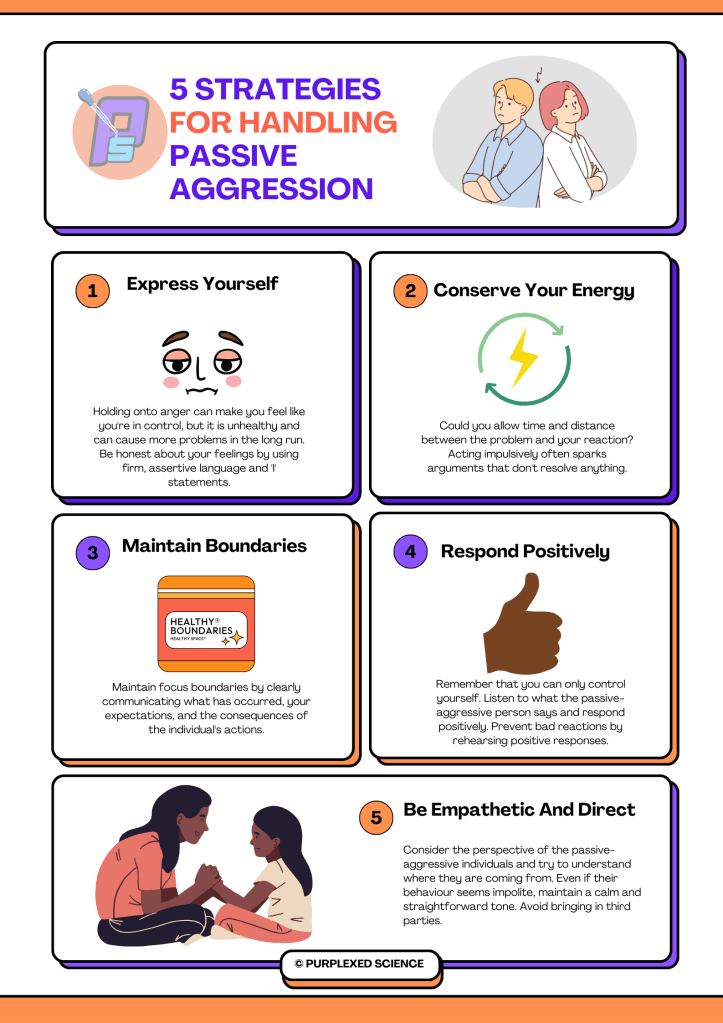
- Express Yourself
Holding onto anger can make you feel like you’re in control, but it is unhealthy and can cause more problems in the long run. Be honest about your feelings using firm, assertive language and ‘I’ statements.
- Conserve Your Energy
Please allow time and distance between the problem and your reaction. Acting impulsively often sparks arguments that don’t resolve anything.
- Maintain Boundaries
Maintain focus boundaries by clearly communicating what has occurred, your expectations, and the consequences of the individual’s actions.
- Respond Positively
Remember that you can only control yourself. Listen to what the passive-aggressive person says and respond positively. Prevent bad reactions by rehearsing positive responses.
- Be Empathetic And Direct
Consider the perspective of the passive-aggressive individuals and try to understand where they are coming from. Even if their behaviour seems impolite, maintain a calm and straightforward tone. Avoid bringing in third parties.
The key takeaway is to avoid confrontation with passive-aggressive people. Use ‘I’ statements instead of ‘you’ to prevent arguments, and if all else fails – walk away.
References
| Title | Link |
|---|---|
| 16 Signs Of Passive-Aggressive Behavior With Examples | Simple Psychology |
| Overcoming Passive-Aggression: How to Stop Hidden Anger from Spoiling Your Relationships, Career and Happiness by Tim Murphy (Author), Loriann Hoff Oberlin (Contributor) | Amazon |
| Specific signs of passive-aggressive behaviour | Mayo Clinic |
| Strategies for passive aggression | Download PDF |






 Purplexed Science
Leave a comment